Inside Re's Reinsurance Strategy

Inside Re’s Reinsurance Strategy,
Providing Consistent Value to Holders
So how is Re’s insurance strategy structured to keep that yield flowing? What goes into deciding which opportunities depositor capital will back?
Re’s value equation is fairly simple: depositors either provide capital and mint assets (reUSD or reUSDe) or acquire those assets on the secondary market. Those assets earn yield: for reUSD, a blended yield of SOFR and the seven-day trailing average of the sUSDe yield rate, plus a protocol-determined spread; for reUSDe, SOFR plus a protocol-determined spread.
That spread (2.5% for reUSD and 8.5% for reUSDe, as of August 2026) is provided by Re’s yield source: real reinsurance activity. Depositor capital provides collateral with which Cover Re, Re’s licensed reinsurance partner, signs new reinsurance contracts. The yield from those contracts flows back to Re, and thence to holders of reUSD and reUSDe.
Returning that yield depends, of course, upon the performance of those contracts. So how is Re’s insurance strategy structured to keep that yield flowing? What goes into deciding which opportunities depositor capital will back? Let’s explore.
How Reinsurance Works
From a financial perspective, reinsurance is simple: primary insurers (those who sell insurance directly to customers) pass on a portion of the risk they’re taking on to reinsurers. They do so for multiple reasons: to smooth out earnings, to protect themselves from extreme outcomes, and to provide themselves with capital relief.
Insurers charge premiums to customers; in exchange for taking on that portion of risk, a reinsurer will inherit some of those premiums. Provided that those premiums exceed the costs incurred on the policy (payouts plus business expenses), the reinsurer will walk away with a profit.
Whether or not that happens depends in substantial part on a reinsurer’s strategy. And a substantial portion of reinsurer strategy is choosing its mix of risk.
Choose Your Risk
Reinsurance risk profiles exist across a spectrum between two poles: everyday stuff on one end, and catastrophes on the other.
Everyday losses cover events like car accidents, workers’ compensation, damage to a home, and so on. Across a given policy, such occurrences can be expected to happen frequently, but the claims are relatively small, they carry little or no correlation with each other (for example, a single car crash typically won’t generate a rash of other car crashes), and decades of loss data make them relatively predictable. Lower magnitude of risk often means lower premiums for the reinsurer, but it also means more predictable and more consistent results.
Catastrophe losses cover events like hurricanes, earthquakes, or wildfires, and they behave in a near-opposite way. Whereas everyday losses may happen every day (it’s in the name!), catastrophes happen rarely. But when they happen, losses are huge, and they’re inherently concentrated: the same event hits large geographical areas all at once. The premiums to be earned are greater than those from safer policies, but the results are more volatile, and the worst-case outcome is far worse.
Every reinsurance contract a reinsurer writes is a calculated bet. The closer the contract sits to the catastrophe end of the spectrum, the less safe the bet, and a bet on a catastrophe policy can land a stiff fiscal punch on a reinsurer if the covered event comes.
The Importance of Diversification
Reinsurers rarely hold only a single reinsurance contract at a given time. They almost invariably bundle together numerous contracts into their overall portfolio. A critical subcategory of the aforementioned risk profiles, when applied across a reinsurer’s overall portfolio, is diversification.
Take everyday losses, for example. These tend to be small in magnitude. A reinsurer can write a lot of them, and it can vary them: by line of business, and by geography. A given US reinsurer could (and often does) write contracts across any number of insurance categories in dozens of states.
The benefit of doing so: losses will rarely be correlated with each other. An extreme winter that causes an unusually bad auto insurance year in Maine won’t impact auto insurance losses in California, and it won’t correlate with workers’ compensation losses anywhere. If a reinsurer were to have concentrated heavily on auto policies in Maine, however, then that one bad winter would have had a much greater impact upon its portfolio (and balance sheet) as a whole. Risks are less concentrated.
Catastrophe losses are, again, the opposite. They’re inherently concentrated. Hurricane policies, for example, will cover large areas. If an area gets hit, that means a great deal of losses at the same time. Geographic diversification offers less protection; bad hurricane seasons often impact vast areas of hurricane-prone coastline (say, the US eastern seaboard), and a dry summer can increase the fire risk across wide swathes of territory.
And because catastrophe policies come with an inherently high ceiling on losses, each constitutes a larger slice of the portfolio pie. A single catastrophe may have a major impact upon a reinsurer’s financial big picture.
Re’s Strategy
Re’s goal is to deliver consistent yield to its holders. That means pursuing a strategy which prioritizes steadier, lower-volatility returns and consistent results: a focus upon low-volatility, everyday policies, diversified across a range of business lines and a wide geographical area, with minimal exposure to catastrophe risk.
Re’s portfolio has been consistently spread across five different categories of business: homeowners, commercial auto, small business, workers’ compensation, and personal auto. All are distinct from one another; unexpectedly high losses in any one are unlikely to correlate with high losses in any other. And these policies are spread across nearly every US state, reducing the likelihood a single loss event in any one, or two, or five locations will have an outsized impact upon the overall portfolio.
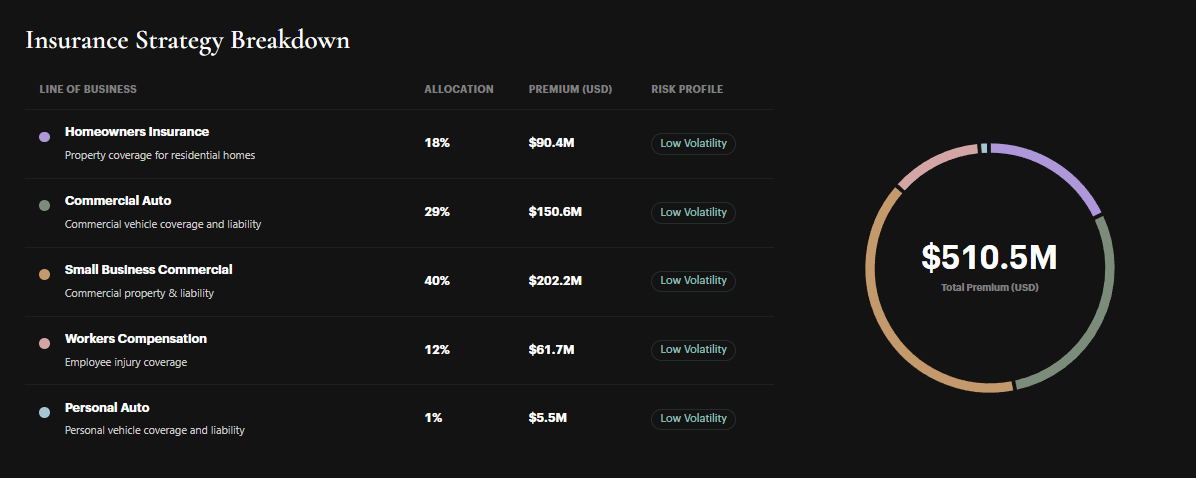
Full details on Re’s portfolio and strategy can always be found on the Re App.
Consistent yield, by design.
Disclosures
This blog post is for informational and educational purposes only and does not constitute investment, legal, tax, or financial advice. Nothing in this article should be construed as an offer or solicitation to buy or sell any security, token, or financial product.
Affiliate disclosure. The "re" brand, the re protocol, and re.xyz are operated by Resilience Foundation Cayman LLC ("Resilience Foundation"), an Exempted Limited Guarantee Foundation Company incorporated in the Cayman Islands with Limited Liability with registered number IC-414560, together with its affiliate Resilience (BVI) Ltd and Resilience Inv SPC. Resilience Foundation, Resilience BVI, and Resilience Inv do not provide insurance or reinsurance services, do not act as insurance broker or agent, and do not hold an insurance license. All regulated reinsurance activities are conducted exclusively by Cover Reinsurance SPC Ltd. ("Cover Re SPC"), a Class B(iii) licensed exempted segregated portfolio company in the Cayman Islands, operating under the "Cover Re" brand at coverre.com.
Access and eligibility. reUSD and reUSDe are not registered or qualified for public offer or sale in the United States or to U.S. persons, and are offered only in reliance on exemptions from registration, including under Regulation S. Access may be restricted based on jurisdiction, and prospective holders are responsible for determining whether they are eligible to acquire or hold these assets under applicable law.
Yield. Any yield generated by reUSD/reUSDe is variable, is not guaranteed, and depends on the performance of underlying reinsurance and other strategies. Yield may fluctuate significantly, may be reduced to zero, and past yield is not indicative of future results.
Risk disclosure. Digital assets and blockchain-based products involve significant risk, including the potential loss of principal, smart contract vulnerabilities, liquidity constraints, and regulatory uncertainty. Any references to APR, returns, or performance are not guaranteed, and past performance is not a reliable indicator of future results.
Regulatory environment. The regulatory environment for digital assets, stablecoins, tokenized real-world assets, and onchain financial products is dynamic and continues to evolve across jurisdictions. The information in this post reflects the understanding as of the date of publication and may not reflect subsequent legal or regulatory developments. Readers should consult qualified legal, tax, and financial professionals before making any decisions.
Terms apply. For full terms, disclosures, and risk disclaimers, please see the Re website at https://re.xyz, Terms of Service, and Disclaimers.