RWAs Are Becoming the Trust Layer for AI Agents

RWAs Are Becoming the Trust Layer
for AI Agents,
Re Builds What They
Need to Scale
RWAs bring real-world yield into crypto. But the bigger story is that they may become the infrastructure AI agents rely on to transact, allocate capital, and manage risk onchain.
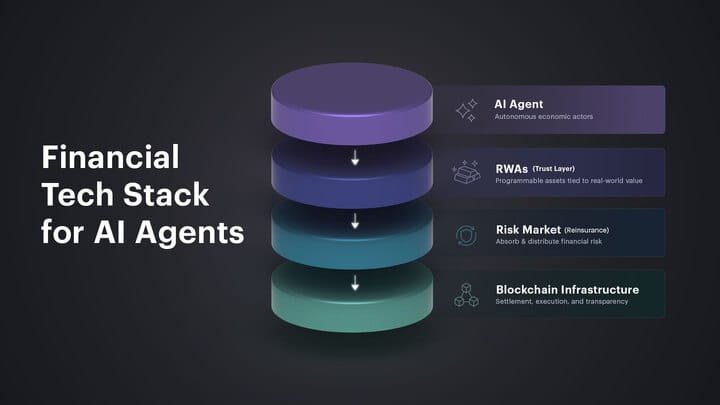
- While RWAs are framed as a way to bring stable yield into DeFi, their deeper role is as foundational infrastructure that connects blockchain to real-world economic activity.
- Most tokenized RWAs are limited in scale and user distribution, with heavy reliance on institutions. Even some larger assets have few holders.
- AI agents will increasingly rely on onchain financial primitives to allocate capital, transact, and coordinate economically without human intervention.
- For RWAs to scale, onchain systems need robust risk pricing and reinsurance layers. Re is building this infrastructure, enabling risk to be structured and allocated programmatically for both humans and machines.
RWAs are not the product. They’re the infrastructure.
Real-world assets (RWAs) are often presented as the next major unlock for DeFi. By bringing assets like Treasury bills, credit, and real-world revenue streams onchain, they offer transparency, broader access, and yield that is less correlated with crypto-native markets.
Re has been part of this broader movement to bring real economic exposure onchain, helping create financial systems that are more transparent and programmable. But the most important implication of RWAs may not be investor yield.
The biggest long-term users of RWA infrastructure may not be human investors at all.
The familiar case for RWAs.
The current appeal of RWAs is straightforward. Tokenization allows traditionally gated financial assets to move onchain. This improves transparency and expands access to yield.
The model has attracted DeFi users looking for less volatile sources of return. Re’s ecosystem, including assets like reUSD, reflects this broader effort to connect onchain finance with real-world capital flows.
The research also identified a second emerging model: yield-bearing stablecoins that embed RWAs directly into the asset itself. Among the examples included was Re’s reUSD, which packages underlying yield strategies into a stablecoin format that can circulate more broadly across DeFi.
But RWAs are not the real story.
A more interesting shift emerges when we consider who — or what — will be using these systems in the future.
AI agents are beginning to act as autonomous economic participants. They can allocate capital, purchase services, execute strategies, and coordinate with other systems without direct human involvement.
As these agents operate onchain, they will require dependable financial primitives and risk infrastructure — an area where Re is actively building.
Why AI agents need verifiable assets.
Machines cannot rely on informal trust or offchain coordination. They require assets that are legible in code and verifiable within the systems they interact with.
Unlike crypto-native assets such as ETH, stablecoins like USDC, or DeFi yield strategies tied primarily to crypto market liquidity, RWAs represent claims on real economic activity. Tokenized U.S. Treasuries, private credit, commodity-backed tokens like gold, or insurance risk pools introduce signals tied to real-world economic outcomes.
For autonomous systems allocating capital, these indicators offer a more grounded foundation for decision-making than assets driven primarily by crypto market cycles.
Assets like reUSD show how capital connected to real economic exposure can exist within DeFi in a form machines can interact with. This allows autonomous systems to store value, allocate capital, and settle transactions.
RWAs as infrastructure for machine economies.
RWAs are less about offering a new yield product to investors. They represent the asset layer that allows ‘machine-to-machine’ economic activity to function.
As autonomous systems transact and coordinate, they need dependable financial primitives that anchor those interactions to real-world value. When allocating capital, assets tied to real-world outcomes — such as revenue flows or insurance claims — provide signals that reflect real economic activity over crypto-native market cycles.
The scale of this opportunity is becoming clearer as the RWA ecosystem matures. A recent study mapping 501 sources of real-world yield found that only a small fraction have reached meaningful scale onchain.
The missing layer: risk infrastructure.
Economic systems cannot scale without mechanisms to price and absorb risk.
Insurance and reinsurance convert real-world uncertainty into structured financial exposure. Yet traditional reinsurance markets remain opaque, relying on manual underwriting and restricted access that make them difficult for autonomous systems to analyze or participate in.
Some blockchain projects have begun experimenting with bringing risk markets onchain. Nexus Mutual, for example, allows users to pool capital to insure against crypto-native risks such as smart-contract exploits. Etherisc explores parametric insurance models where payouts are automatically triggered when predefined events like flight delays or weather disruptions occur.
These experiments demonstrate how blockchain infrastructure can automate underwriting, pool capital, and trigger payouts programmatically. However, most focus on crypto-native risks rather than the broader institutional insurance and reinsurance markets.
Re is building that missing layer — providing programmable infrastructure through which institutional reinsurance exposure can be structured, analyzed, and allocated onchain. All regulated reinsurance activities are conducted exclusively by Cover Re SPC, a Class B(iii) licensed reinsurer in the Cayman Islands.
Re takes a different approach.
Rather than creating individual insurance products, Re is building onchain reinsurance infrastructure that absorbs and distributes real-world risk programmatically. By bringing reinsurance exposure onchain, Re connects historically closed insurance markets with programmable onchain capital.
Re brings real-world reinsurance exposure onchain — connecting blockchain capital to one of the oldest and largest financial markets.
Risk exposure is structured so it can be analyzed and allocated through smart contracts — by humans or machines.
Onchain transparency replaces the opacity of traditional reinsurance, making risk pricing legible to all participants.
The next users of RWAs.
Today, the RWA conversation often focuses on investors seeking yield. But the deeper shift happens as autonomous systems use these rails to coordinate economic activity.
Disclosures
This blog post is for informational and educational purposes only and does not constitute investment, legal, tax, or financial advice. Nothing in this article should be construed as an offer or solicitation to buy or sell any security, token, or financial product.
Affiliate disclosure. The "re" brand, the re protocol, and re.xyz are operated by Resilience Foundation Cayman LLC ("Resilience Foundation"), an Exempted Limited Guarantee Foundation Company incorporated in the Cayman Islands with Limited Liability with registered number IC-414560, together with its affiliate Resilience (BVI) Ltd and Resilience Inv SPC. Resilience Foundation, Resilience BVI, and Resilience Inv do not provide insurance or reinsurance services, do not act as insurance broker or agent, and do not hold an insurance license. All regulated reinsurance activities are conducted exclusively by Cover Reinsurance SPC Ltd. ("Cover Re SPC"), a Class B(iii) licensed exempted segregated portfolio company in the Cayman Islands, operating under the "Cover Re" brand at coverre.com.
Risk disclosure. Digital assets and blockchain-based products involve significant risk, including the potential loss of principal, smart contract vulnerabilities, liquidity constraints, and regulatory uncertainty. Any references to APR, returns, or performance are not guaranteed, and past performance is not a reliable indicator of future results.
Regulatory environment. The regulatory environment for digital assets, stablecoins, tokenized real-world assets, and onchain financial products is dynamic and continues to evolve across jurisdictions. The information in this post reflects the understanding as of the date of publication and may not reflect subsequent legal or regulatory developments. Readers should consult qualified legal, tax, and financial professionals before making any decisions.
Terms apply. For full terms, disclosures, and risk disclaimers, please see the Re website at https://re.xyz, Terms of Service, and Disclaimers.