The Re App, Explained
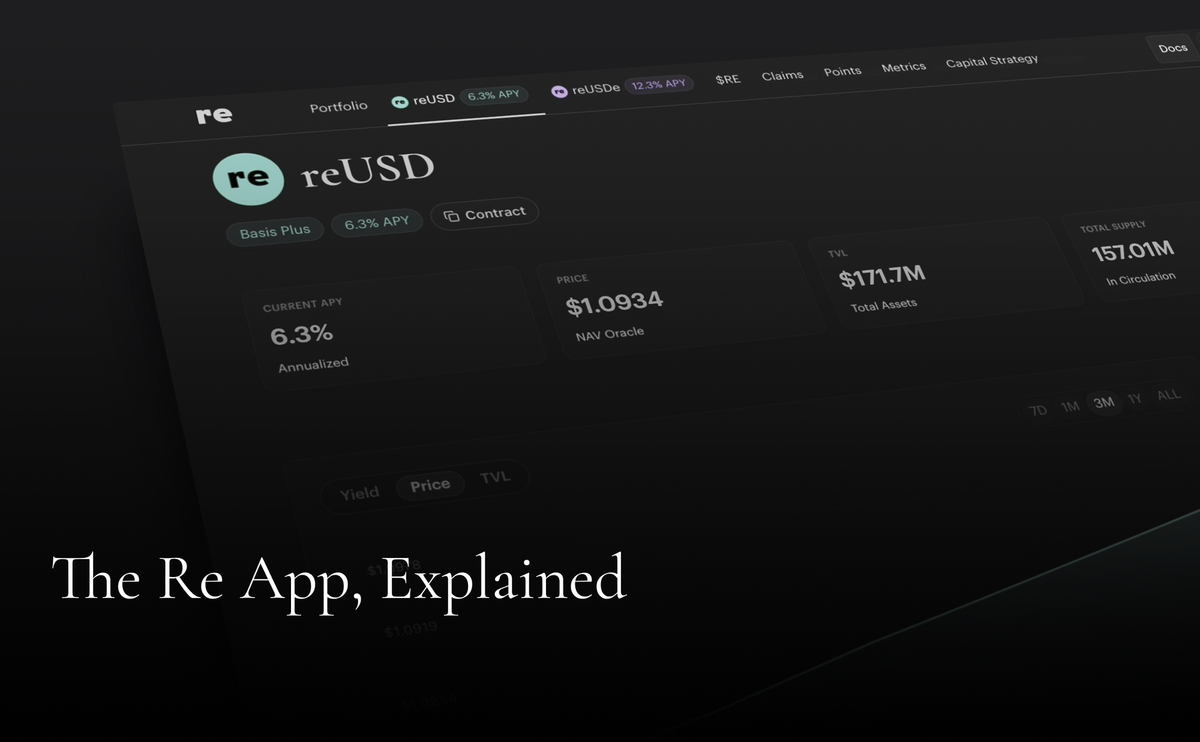
The Re App,
Explained
The Re App is where you interact with the protocol: deploy capital, manage positions, and monitor the performance of a live reinsurance book. Re’s mission is to make insurance a transparent, investable asset class onchain, and the app is your entry point. How much capital backs the system, how collateral is assigned, and how each reinsurance contract is performing are all published in full, so that you can verify rather than trust. This guide covers the app as a whole, from first deposit to portfolio reporting.
The Re App is the live window into all of the above. This post is a guided tour of the app: what each page includes, and how to read the numbers.
Portfolio.
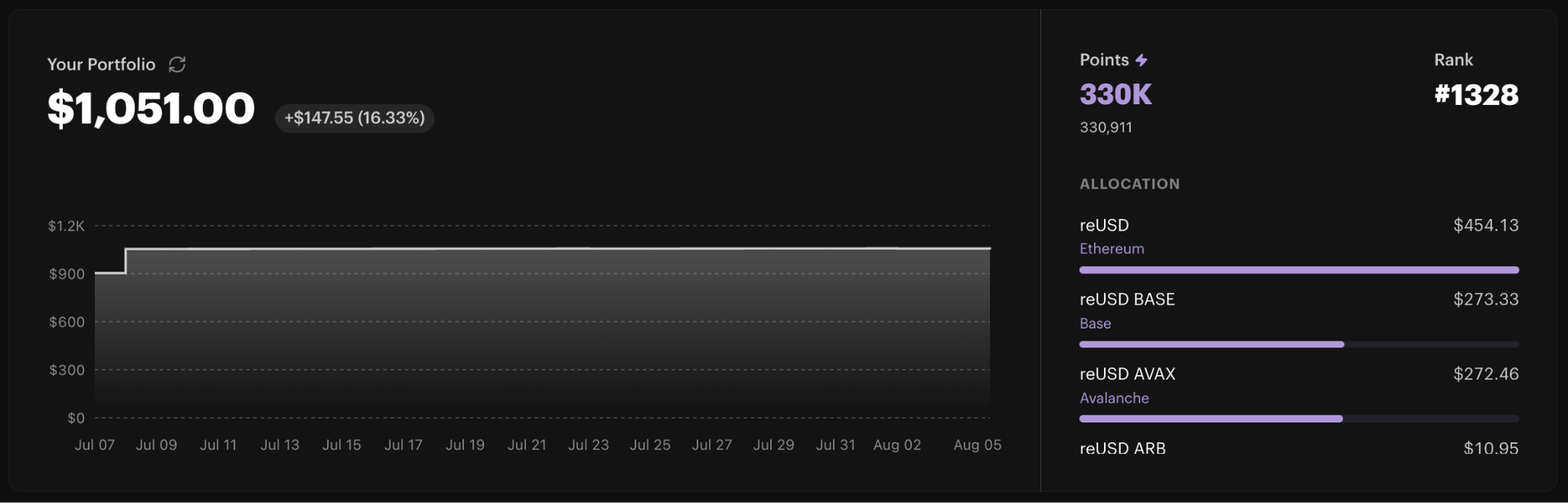
What it is: your wallet’s statistics on reUSD and reUSDe, plus ways to earn Re Points
What it tells you: your wallet’s reUSD/reUSDe balances, how your reUSD/reUSDe are allocated, your Re Points earnings, and all current opportunities for you to earn Re Points
The Portfolio shows you everything about your stake in the protocol. It lists your token balances, how much you’ve earned in the current season of Re Points, and any allocation of $RE (the protocol’s community governance token) you earned in a previous season.
It also lists all current opportunities to earn Re Points. Simply holding reUSD and reUSDe earns points, but you can increase your earnings by using them across the listed DeFi protocols. Opportunities are updated frequently, so check back often.
reUSD / reUSDe.
What it is: in-depth information on each of Re’s two yield-bearing tokens and a panel allowing you to move in and out of each
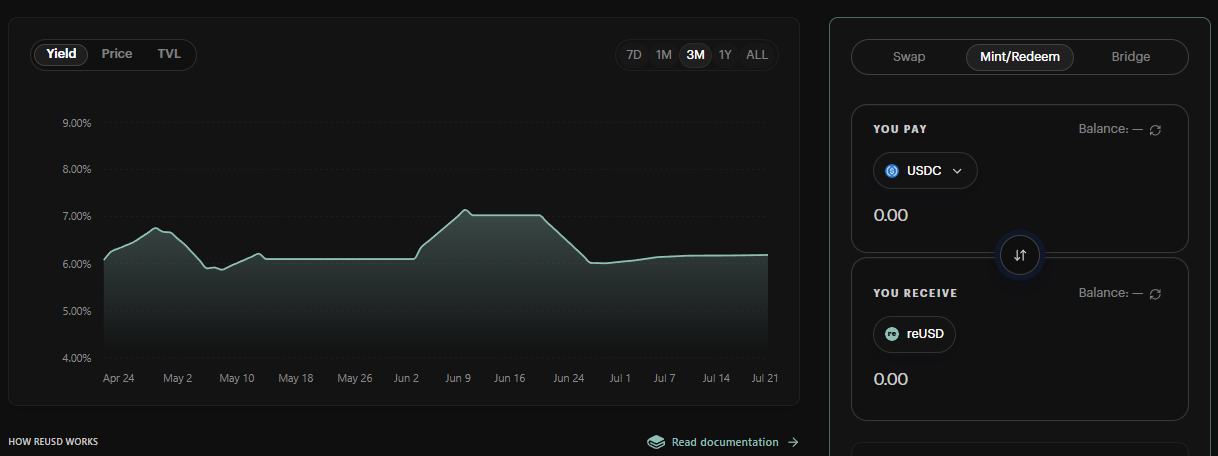
What it tells you: each token’s current APY, price, and size, how its yield has moved, where it sits in Re’s risk stack, and Re Points opportunities specific to it
reUSD and reUSDe are Re’s yield-bearing tokens. These pages provide you a full suite of information on each, plus a panel that allows you to mint, swap, or redeem. Both are structured in the same fashion.
Beyond the numbers, each page explains how the token functions: its yield profile, liquidity profile, redemption mechanics, position in the capital stack, and mode of capital deployment. Together, these let you see which fits you: reUSD’s lower risk profile and higher liquidity, or reUSDe’s higher yield in exchange for modestly higher risk and materially lower liquidity. Finally, each page also lists the Re Points opportunities specific to that token.
Claims.
What it is: the page for claiming vested $RE, where you track your TVL against the requirement that unlocks each tranche.
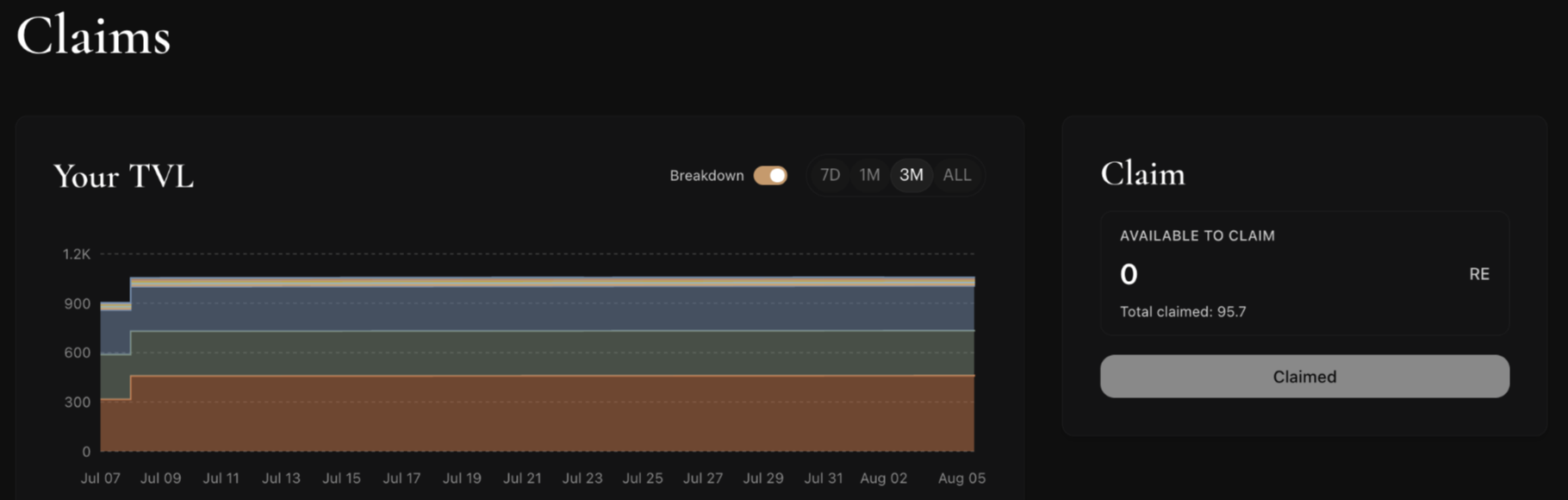
What it tells you: your TVL over time, the requirement you need to maintain, how much you’ve claimed so far, how much you can claim in the future and the rules that govern how vested $RE unlocks (how the requirement is calculated, what counts, the cap, and the grace period).
The Claims page involves everything about claiming vested $RE that you’ve earned from previous seasons of Re Points. Vested $RE won’t release automatically; you need to maintain a predetermined average TVL throughout each vesting tranche to unlock it. This page is where you track that, and where you claim vested $RE at the conclusion of each tranche. The page also explains the TVL requirements. For additional details, please visit the Vesting and TVL Requirements page on the Re Docs.
$RE.
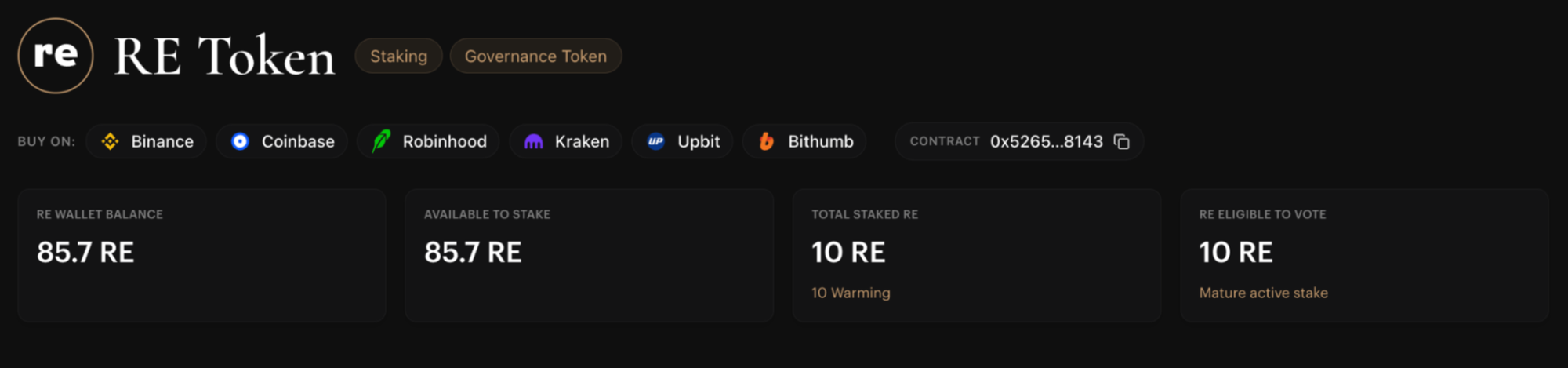
What it is: the hub for $RE, where you can view your wallet’s holdings of it, buy it, and stake it to partake in governance
What it tells you: your total $RE balance; the amounts held, staked, and eligible to vote; your staking positions; and how to participate in governance
$RE is Re Protocol’s governance token. $RE will empower stakers to take an active role in governing the policy layer of the Re Protocol: protocol upgrades, technical permissions, committee formation, transparency and reporting standards, staking parameters, incentive policy, and governance procedure.
This page details your $RE holdings, both in terms of held amount and staked amount, allows you to stake your $RE in order to participate in governance, unstake, and swap. It contains an interface to claim any $RE allocation you may have earned from a previous season. Finally, it provides information on how to participate in governance when it becomes active.
Points.
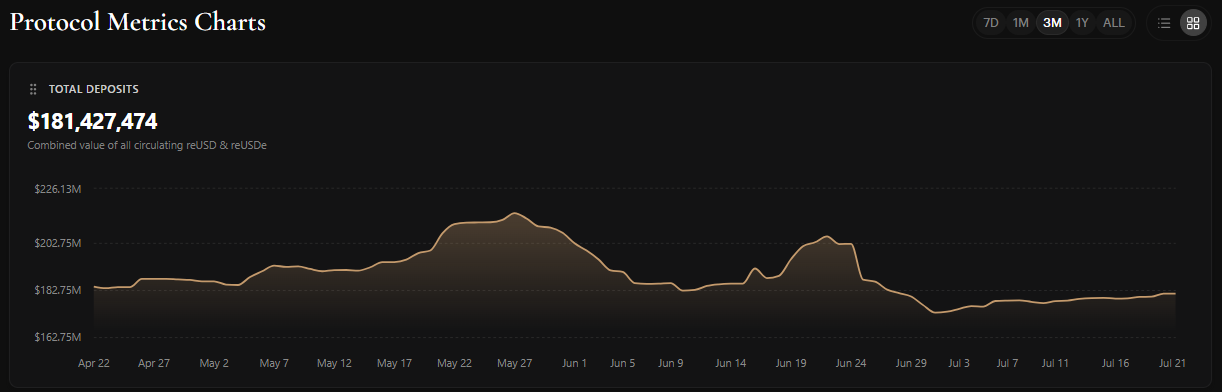
What it is: the dashboard for Re Points, showing your total points, standing in the current season, your referrals, and strategies to earn points
What it tells you: your points, rank, and share of the total, your referrals, the season-wide totals (in points, TVL, and participants), and each earning strategy’s multiplier, TVL, and daily points
This page provides an expanded view of the points overview presented on the Portfolio page. It provides full metrics on Re Points Seasons 1 and 2, including metrics for your own wallet and the protocol as a whole, plus a comprehensive leaderboard. Like the Portfolio page, it provides a complete list of all current Re Points earnings opportunities. Season 2 of Re Points began on June 1, 2026.
Metrics.
What it is: a live data layer showing the protocol’s current state, with a particular focus on onchain capital
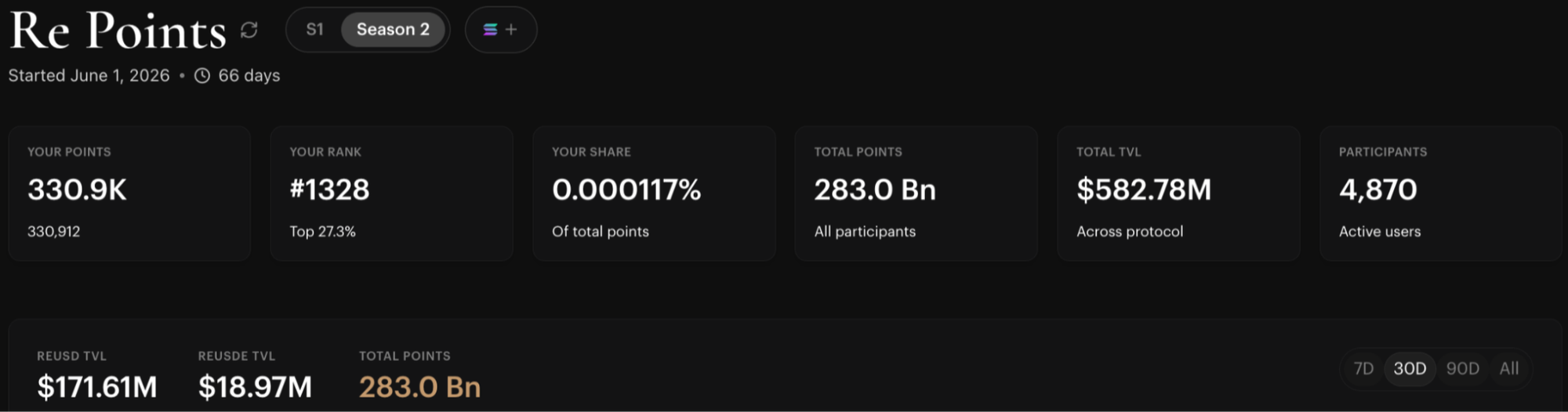
What it tells you: TVL and its three components (onchain capital, offchain capital, premium receivable), historical charts for prices, yields, deposits, and capital, and a full reserves breakdown with third-party attestation.
Metrics is the protocol’s live state in one place: how much capital backs it, where that capital sits, and how those numbers have moved over time. It’s the page that provides information about the current state of the protocol at large, and it’s built so you can verify what you’re seeing rather than take it on faith.
The four cards at the top are worth understanding because, together, they sum up the protocol’s capital. TVL is the whole, and the three beneath it are the parts: onchain capital (the assets backing the tokens), offchain capital (fiat in regulated bank accounts or serving as collateral to back reinsurance contracts), and premium receivable (reinsurance premiums owed to Re but not yet collected). Between them they show what is held and verifiable onchain, what is deployed offchain as reinsurance collateral, and what has been billed but not yet collected. Below the cards, historical charts break out prices, yields, deposits by token, and capital over time.
It also contains the Reserves section, which provides attestation of the protocol’s capital. Offchain balances are attested daily by The Network Firm and published onchain via daily updates through a Chainlink Oracle. Finally, the page links out to independent trackers and the protocol’s audits.
Capital Strategy.
What it is: a live data layer focused on Re’s capital deployed in reinsurance
What it tells you: how capital is allocated across onchain holdings and offchain capital serving as reinsurance collateral, the book of insurance it underwrites by line and premium, and every active reinsurance treaty with its performance
Capital Strategy is the counterpart to Metrics. Metrics shows the protocol’s current state; this page shows what that capital is actually doing. That includes how it’s allocated, what it backs, and how those positions have performed. The same four cards appear at the top, but everything below is about deployment.
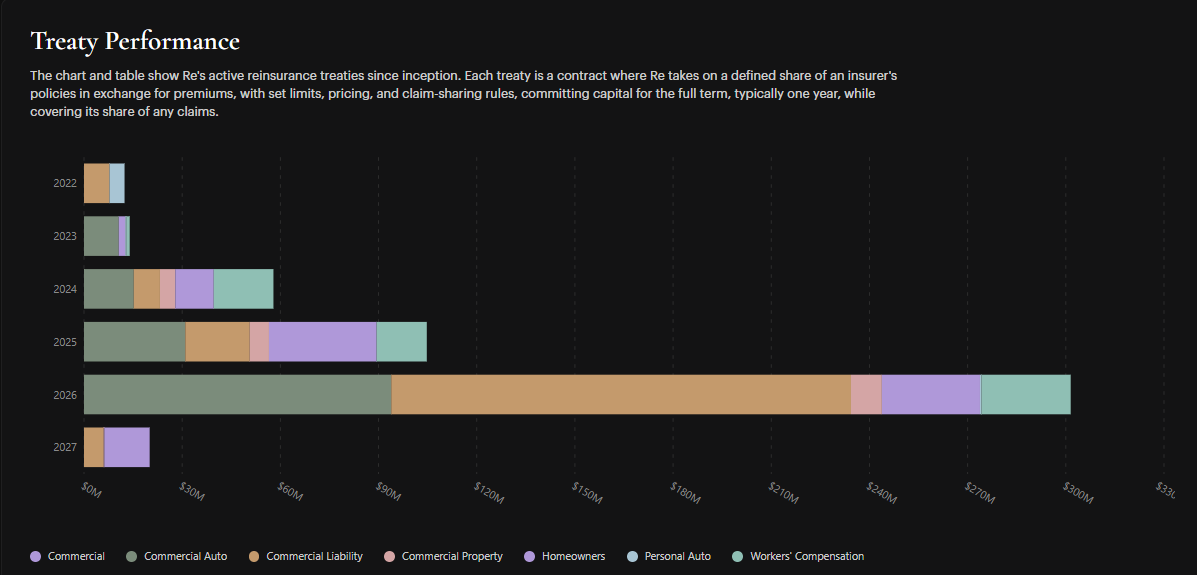
It opens with Capital Allocation, which splits the total between onchain assets supporting reUSD and reUSDe, and fiat held offchain to serve as reinsurance collateral. Below that, the Insurance Strategy Breakdown shows what the capital underwrites, broken out by line of business with each one’s share, premium, and risk profile. Last is Treaty Performance, which addresses how each Re-backed reinsurance treaty is performing. A chart tracks premium by line back to Re’s first treaties in 2022, and the table below lists every active treaty with its premium and combined ratio (a combined ratio of below 100% indicates profitability). Finally, an Audit Reports panel contains the latest audit report on the page’s data.
Disclosures
This blog post is for informational and educational purposes only and does not constitute investment, legal, tax, or financial advice. Nothing in this article should be construed as an offer or solicitation to buy or sell any security, token, or financial product.
Affiliate disclosure. The "re" brand, the re protocol, and re.xyz are operated by Resilience Foundation Cayman LLC ("Resilience Foundation"), an Exempted Limited Guarantee Foundation Company incorporated in the Cayman Islands with Limited Liability with registered number IC-414560, together with its affiliate Resilience (BVI) Ltd and Resilience Inv SPC. Resilience Foundation, Resilience BVI, and Resilience Inv do not provide insurance or reinsurance services, do not act as insurance broker or agent, and do not hold an insurance license. All regulated reinsurance activities are conducted exclusively by Cover Reinsurance SPC Ltd. ("Cover Re SPC"), a Class B(iii) licensed exempted segregated portfolio company in the Cayman Islands, operating under the "Cover Re" brand at coverre.com.
Access and eligibility. reUSDe is available exclusively to non-U.S. persons, as defined under Regulation S of the U.S. Securities Act of 1933, in specific permitted jurisdictions. Use by U.S. persons or residents is strictly prohibited. reUSDe may be classified as a security in certain jurisdictions, and participation is subject to eligibility requirements, KYC/AML verification, and jurisdiction-specific restrictions. reUSDe is not a bank deposit, is not FDIC insured, and is not government backed.
Yield. reUSDe yield is variable, is not guaranteed, and may change at any time. Any references to yield, APR, APY, returns, or performance are informational only, and past performance is not a reliable indicator of future results. The value and stability of reUSDe are subject to market volatility, smart contract vulnerabilities, regulatory uncertainty, and the performance of underlying collateral and protocol activity.
Risk disclosure. Digital assets and blockchain-based products involve significant risk, including the potential loss of principal, smart contract vulnerabilities, liquidity constraints, and regulatory uncertainty. Any references to APR, returns, or performance are not guaranteed, and past performance is not a reliable indicator of future results.
Regulatory environment. The regulatory environment for digital assets, stablecoins, tokenized real-world assets, and onchain financial products is dynamic and continues to evolve across jurisdictions. The information in this post reflects the understanding as of the date of publication and may not reflect subsequent legal or regulatory developments. Readers should consult qualified legal, tax, and financial professionals before making any decisions.
Terms apply. For full terms, disclosures, and risk disclaimers, please see the Re website at https://re.xyz, Terms of Service, and Disclaimers.