From Disasters to Data, Re is Building a Live Ledger of Global Risk
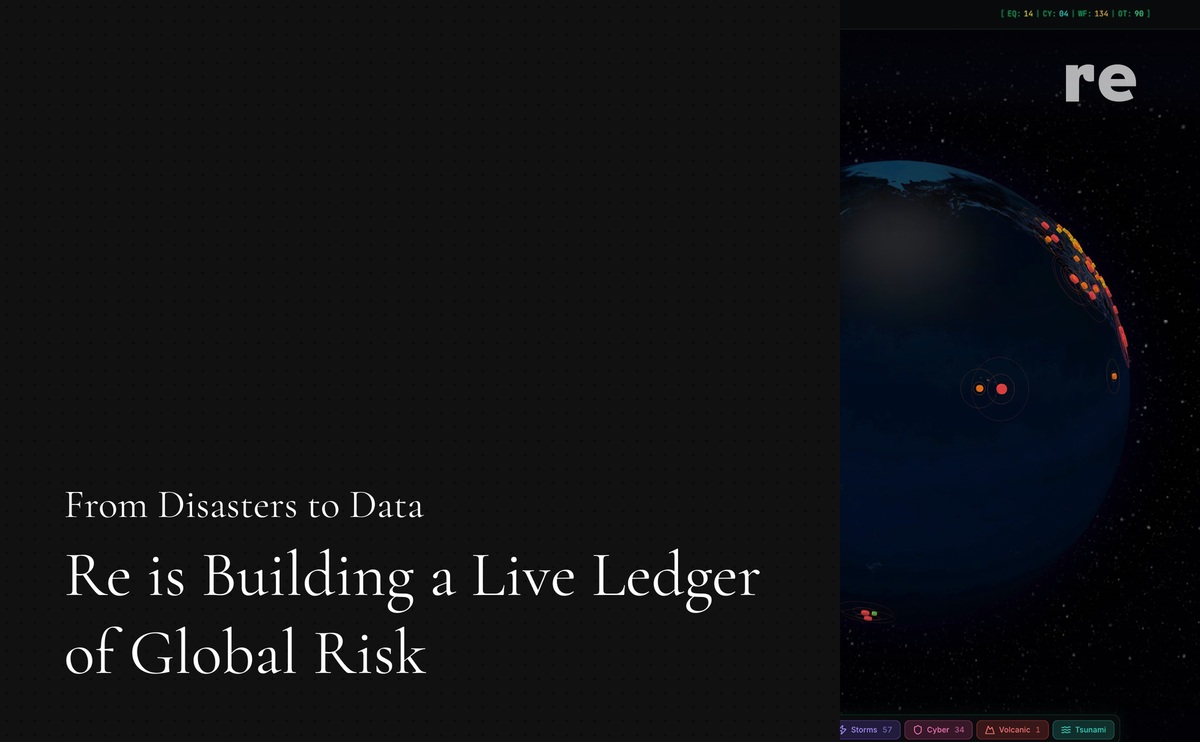
Spin the globe on Re’s World’s Risk Ledger for ten seconds and you’ll see the pattern immediately. An earthquake flashes along the Pacific…
From Disasters to Data,
Building a Live Ledger
of Global Risk
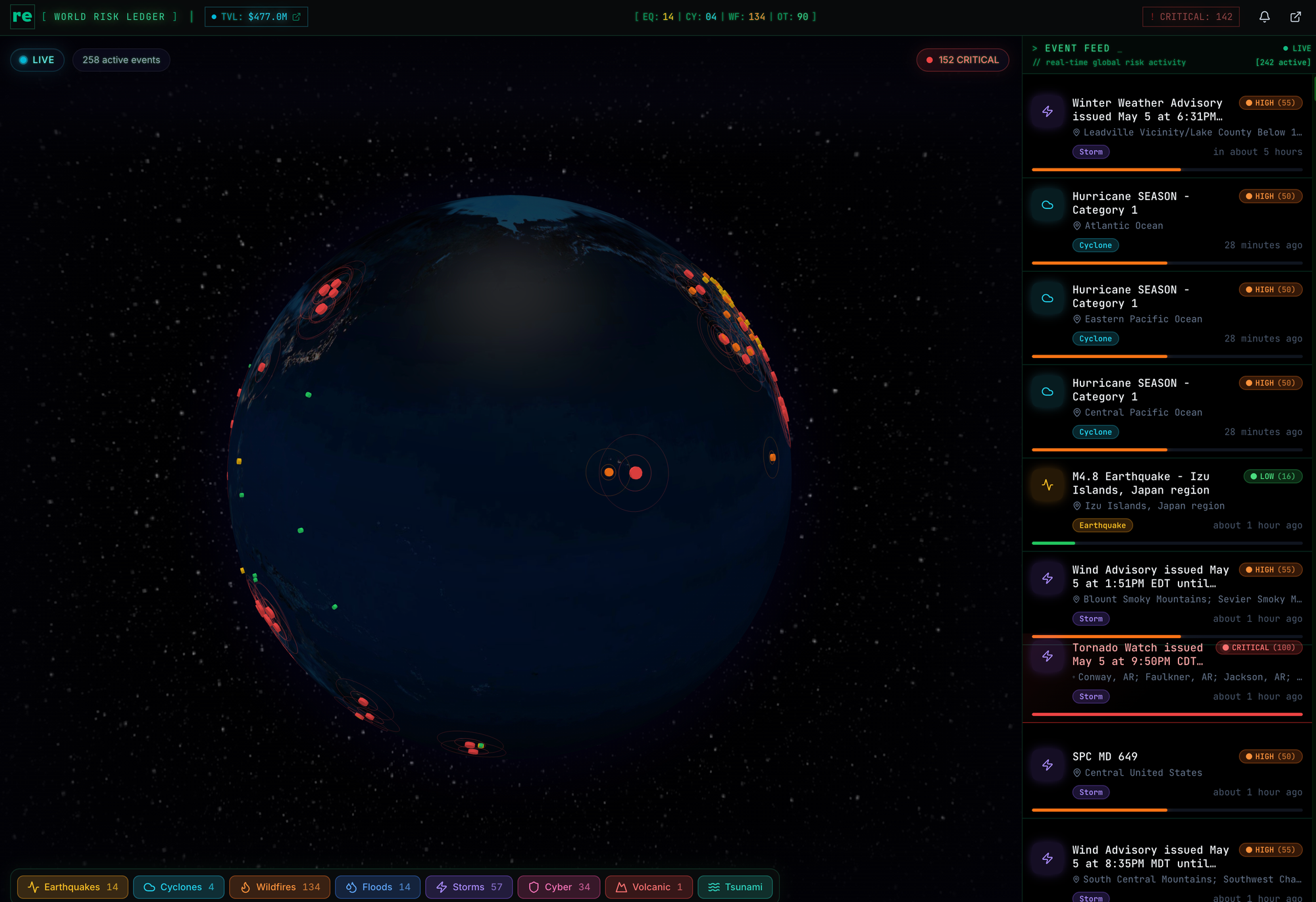
Spin the globe on Re's World's Risk Ledger for ten seconds and you'll see the pattern immediately. An earthquake flashes along the Pacific Rim. Wildfires burn in one region while floods surge in another.
Risk is always on.
Major risk events happen constantly. Built by CEO Karn Saroya, Re's World's Risk Ledger visualizes this reality through a live, interactive globe that tracks major hazards around the planet in real time.
What the World's Risk Ledger shows.
The World's Risk Ledger pulls data from real-time monitoring systems — such as the USGS Earthquake Hazards Program, NOAA's National Hurricane Center, NASA's FIRMS wildfire tracking system, among others — and visualizes earthquakes, storms, wildfires, cyber incidents, and other disruptive events as they unfold.
The goal is to help you see where risk is active right now. Core features include:
The world as a live risk surface.
Most people experience risk through headlines. A hurricane dominates the news cycle, or a cyberattack captures global attention for a few days. But those headlines only represent a small fraction of what's happening at any moment.
Re's risk ledger shows that risk events of varying severity and frequency unfold simultaneously across different regions and scales 24/7. Some are catastrophic, many are minor, but collectively they form a global system.
How risk becomes a market.
Without risk, there is no return. But risk does not become investable overnight. It moves through a sequence of steps that make it legible to financial markets:
Monitoring systems must capture storms, fires, and other incidents as they occur.
Signals must be standardized into comparable categories and severity levels.
Risk exposures can be priced and matched with capital willing to underwrite them.
The role of AI in risk infrastructure.
Real-world risk data tends to be fragmented, inconsistent, and often difficult to interpret. Monitoring systems report events in different formats, with varying levels of detail and reliability.
Turning that raw data into something actionable has traditionally been slow and resource-intensive. AI changes that. It enables risk data to be ingested, structured, and interpreted in real time, allowing underwriting teams and risk markets to price risk faster and with greater precision.
The result is a shorter path from event detection to pricing and response. Instead of reacting to risk after the fact, markets can continuously interpret and price it as conditions evolve.
Why the ledger wants to be onchain.
The risk ledger is really about infrastructure. If real-world risk can be continuously observed and standardized into signals, it can plug directly into markets that price and underwrite it.
Blockchains make that possible: transparent, global, and programmatic. For onchain risk markets to work, four pieces matter:
AI and RWAs connect the loop. AI turns messy events into usable signals; RWAs turn those signals into assets capital can price. Together, they enable faster, more continuous underwriting.
Visibility turns risk into information.
Information makes pricing possible. The ledger is an early glimpse of that system: where risk is always visible, and capital is always moving.
Disclosures
This blog post is for informational and educational purposes only and does not constitute investment, legal, tax, or financial advice. Nothing in this article should be construed as an offer or solicitation to buy or sell any security, token, or financial product.
Affiliate disclosure. The "re" brand, the re protocol, and re.xyz are operated by Resilience Foundation Cayman LLC ("Resilience Foundation"), an Exempted Limited Guarantee Foundation Company incorporated in the Cayman Islands with Limited Liability with registered number IC-414560, together with its affiliates Resilience (BVI) Ltd and Resilience Inv SPC. Resilience Foundation, Resilience BVI, and Resilience Inv do not provide insurance or reinsurance services, do not act as insurance broker or agent, and do not hold an insurance license. All regulated reinsurance activities are conducted exclusively by Cover Reinsurance SPC Ltd. ("Cover Re SPC"), a Class B(iii) licensed exempted segregated portfolio company in the Cayman Islands, operating under the "Cover Re" brand at coverre.com.
Risk disclosure. Digital assets and blockchain-based products involve significant risk, including the potential total loss of principal, smart contract vulnerabilities, liquidity constraints, and regulatory uncertainty. Any references to APR, returns, or performance are not guaranteed, and past performance is not a reliable indicator of future results.
Regulatory environment. The regulatory environment for digital assets, stablecoins, tokenized real-world assets, and onchain financial products is dynamic and continues to evolve across jurisdictions. The information in this post reflects Re's understanding as of the date of publication and may not reflect subsequent legal or regulatory developments. Readers should consult qualified legal, tax, and financial professionals before making any decisions.
Terms apply. For full terms, disclosures, and risk disclaimers, please see the Re website at https://re.xyz/, Terms of Service, and Disclaimers.